🌡️ Complete Guide: Thermal Cameras FAQ
Monitoring independent of light and weather. Find out how thermal cameras work in perimeter protection, which differs from classic cameras, how they detect fires and what advanced bispectral systems are.
1. How does the thermal camera work in the surveillance system? +
Unlike classic cameras, thermal camera does not need any light source visible or infrared (IR) lamps. This device has a special sensor (microbolometer) that records the invisible thermal radiation (LWIR long-term infrared) emitted by each object with a temperature above absolute zero. Then the camera processor transforms these temperature differences into a clear image (thermogram) on which warmer objects (e.g. man, animal, engine working) clearly cut off from the cold background.
2. What is the difference between a thermal camera and a normal infrared (IR) camera? +
The classic camera at night "lights" the IR light area, which reflects from objects and returns to the lens – if thick fog, heavy rain, snow or bushes appear on the road, the IR light will bounce from them and blind the camera. External thermal imaging camera It does not emit any light. She "sees" the warmth of her own intruder, so that she can easily detect a man or vehicle in absolute Egyptian darkness, flowing against the current of dense smoke, fog, or even hidden behind rare bushes.
3. What is a bispectral camera, and what are its advantages? +
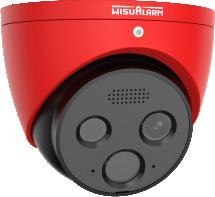
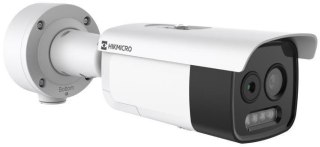
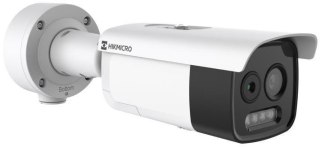
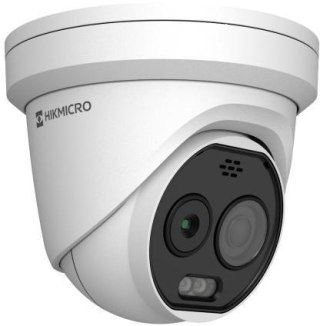
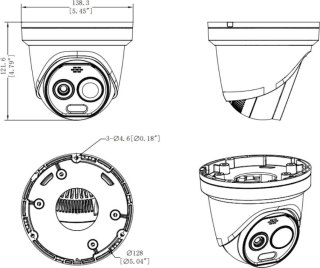
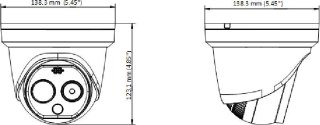
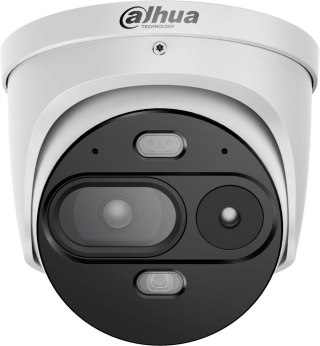
Bispectral camera is an advanced 2w1 device that has two independent lenses and transducers in one housing: one traditional (optical for visible light) and the other thermal. Thanks to this connection, the monitoring system is gaining powerful capabilities: the thermal lens clearly detects motion and temperature anomalies from a huge distance, and the optical lens allows the operator to accurately verify details (e.g. identification of the face of the intruder, color of clothing or vehicle registration numbers).
4. Where is fixed thermal monitoring most often used? +
Thermal surveillance systems are commonly used in high-risk areas and where reliable perimeter protection of large areas is required. They are perfect for securing state borders, airports, power stations, military bases, ports, large photovoltaic farms, as well as in industry: in landfills, sawmills, hangars and inside production halls for constant monitoring of machine and transformer temperatures.
5. How does a thermal camera protect objects from fire? +
This is one of the biggest advantages of this technology. Classic smoke detectors or optical cameras only react when the fire has already exploded and there is visible smoke or fire. Thermovision camera with fire detection function It continuously measures the temperature at hundreds of frame points. It is able to detect anomalous temperature rise (e.g. overheating cable, smoky pile of garbage or biomass) long before an open flame appears, sending an immediate alert to fire systems.
6. Why do thermal camera resolutions (e.g. 160x120 or 384x288) seem so small? +
In the world of optical cameras the standard is megapixels (4K, 8MP), but in thermal vision the physics of sensors looks completely different. The production of heat recorders is extremely complicated and costly. Row Resolutions 160×120, 384×288 or 640×512 pixels are fully sufficient for AI analytical algorithms to reliably detect and classify a human figure from a distance of several hundred meters. Each pixel in such a camera is actually a precise, independent temperature measurement point.
7. Can a thermal camera "see" through windows? +
Contrary to common myths from old action films – **no, the thermal camera does not see through glass**. For thermal radiation (LWIR wavelength), a simple window window window acts as an opaque mirror. If you point the thermal camera at the window, you will not see what is going on inside the building, but you will see the thermal reflection of the camera itself or the surroundings behind it. For the same reason, the lenses of these cameras are not made of glass, but from expensive, rare metal – German.
8. What is the NETD parameter in the specification of the thermal camera and why is it important? +
NETD (Noise Equivalent Temperature Difference) is a key indicator of camera thermal sensitivity, expressed in millikelwines (mK). It specifies how minimal temperature differences the device sensors are able to distinguish from each other. The smaller the NETD value (e.g. ≤35 mK is better than ≤50 mK), the camera is tenderer and the generated thermal image is more detailed, noise-free and more precise, which has colossal significant during difficult weather conditions (e.g. during fog or rain).
9. Do thermal cameras support intelligent AI image analysis? +
Yeah, and there's their greatest force in this combination. Modern thermal vision cameras Hikvision HeatPro whether Dahua have built-in powerful Deep Learning algorithms. Since the thermal image of a human figure or warmed-up vehicle is perfectly cut off from the environment, artificial intelligence algorithms are characterized by **almost 100% effectiveness of intruder detection** (perimetric protection, line crossing, intrusion), eliminating virtually zero false alarms caused by wind, leaf or shadows.
10. What do color palettes (e.g. Ironbow, White Hot, Black Hot) mean in camera settings? +
Because thermal radiation is invisible, the camera image must be artificially colored by the software to become readable to the human eye. Colour pallets serve this purpose. White Hot displays the highest temperature as bright white, and the coldest as black (very natural to detect people). Ironbow or Rainbow uses shades of violet, blue, orange and bile – this pallet is ideal for precise technical measurements and location of the overheating sites.
11. Will the standard NVR network recorder handle the IP thermal camera? +
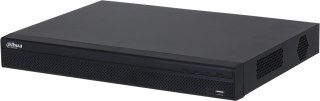
Yes, provided that the brand or ONVIF standard is compatible. IP thermal camera sends to the network a standard digital video stream compressed with H.265 or H.264 codec, exactly as a normal camera. Each modern NVR IP recorder will save this image to the disk. However, in order to be able to fully manage advanced thermography functions, temperature metadata and fire alarm handling, it is recommended to use recorders of the same series/producer as the camera (e.g. Hikvision I/K/M series).
12. How far can a thermal camera detect a human being from? +
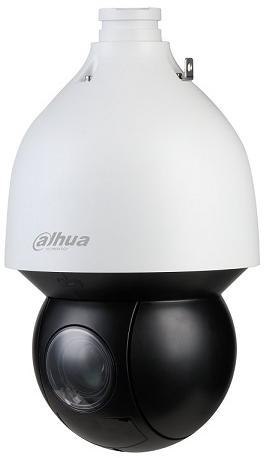
The range depends directly on the focal length of the German lens used and the sensor resolution. Basic compact Hikvision thermal cameras with a lens with a focal length of 3mm or 6mm can easily detect the presence of a person from a distance from 150 to 300 metres. Professional long-range models, equipped with narrow-angle lenses (e.g. 25mm, 50mm or changeling lenses), can detect a human figure from a distance of **a few kilometres**, making them irreplaceable in strategic protection.
13. What is the difference between temperature measurement (thermography) and normal thermal preview? +
Basic safety cameras show only a thermal image (where it is warmer and where it is colder), without giving specific values. In turn ** thermal cameras (measurement cameras)** are devices precisely calibrated radiometrically. They allow the user to click on any point on the screen and read the exact temperature of the object to ±2°C (or even ±0.5°C). This enables constant control of technological processes in factories and instant detection of overheating of equipment.
14. What is the function "Imaging Fusion" in dual cameras? +
Image fusion (two lens) is an innovative software feature that imposes two images in real time: a translucent, color thermal image is perfectly adapted into a sharp, detailed image from an optical lens. This allows the monitoring operator to see on one screen both precise edges, subtitles or ambient details, as well as the accurate spread of heat or the precise location of the ignition point.
15. What is the emission factor and why do you have to set it in a thermal camera? +
Various materials (e.g. wood, concrete, matt plastic or polished metal) at the same temperature with different efficiency give (emit) heat radiation. This capacity shall be determined by the emission factor ( To thermal camera with temperature measurement it gave 100% true results, the installer must enter an appropriate emission value for the test surface in the device menu (e.g. for human skin it is about 0.98, and for matte steel approx. 0.80).
16. Will the dense green wall (trees, hedges) completely block the image from the thermal camera? +
The thermal camera is not a radar that penetrates walls. If the leaves and branches form a compact, dense, non-opening green barrier, they will block the heat radiation coming from the man behind them (the camera will then show the outer temperature of the leaves). However, if the bushes are rare, hollow or branches do not have leaves in the winter, the heat radiation will easily penetrate the cracks, and the intelligent analyst AI in IP thermal imaging camera immediately detect the heat point moving between them.
17. What is the "Blackout" thermovision matrix and how to protect the camera from the sun? +
The sun emits gigantic amounts of heat. Pointing the camera sensor directly to the solar shield can lead to thermal damage or burning of a sensitive microbolometric matrix. Modern, professional CCTV thermal cameras have built-in sun protection software ("Sun Protection"). When the algorithm detects extreme energy point focus, it automatically blocks the area or controls the iris, protecting the expensive optoelectronic system from destruction.
18. How is the external fixed IP thermal cameras powered? +
Identical to standard advanced IP monitoring. These devices support the most convenient supply standard PoE (Power over Ethernet) – most often in the stronger version 802.3at (PoE+) or 802.3bt (Hi-PoE), which allows the transmission of data and current needed, among others, to power the built-in automatic housing heaters. Alternatively, most models have a traditional screw connector for a power supply of 12V DC or 24V AC.
19. What is Blackbody and when is required? +
Black Body (Blackbody) is an external reference device that continuously maintains a specified, perfectly stable temperature (e.g. 35.°C) and is mounted in the camera's field of view. The camera continuously calibrates its sensor against this device. The use of Blackbody is essential in advanced medical and airport systems for mass, touch-free screening of human body temperature, as this allows to raise the measuring accuracy of the camera to amazing ±0.3°C.
20. Why invest in the thermal system at MikaShop.pl? +
The implementation of professional thermal monitoring requires great engineering knowledge. By purchasing equipment at MikaShop.pl, you gain not only original equipment from the official Polish distribution network with full manufacturer's guarantee, but above all the technical support of our certified designers and installers**. We will help you convert the range of german lenses into your area, we will select the appropriate software and help you remotely implement and configure the AI analytical rules and early fire warning thresholds!